 Hikaku
How to tell if a photo is AI-generated: a 2026 guide
No single test tells you for sure whether a photo was made by AI. What works is stacking a few quick checks, because each one catches things the others miss. Here's the order we use, from fastest to slowest.
The short version
- Find out where the photo came from. Real events usually have more than one photographer.
- Check what the file says about itself: Content Credentials, IPTC labels and generator tags.
- Zoom in on the details AI still gets wrong: text, reflections, edges and repeated patterns.
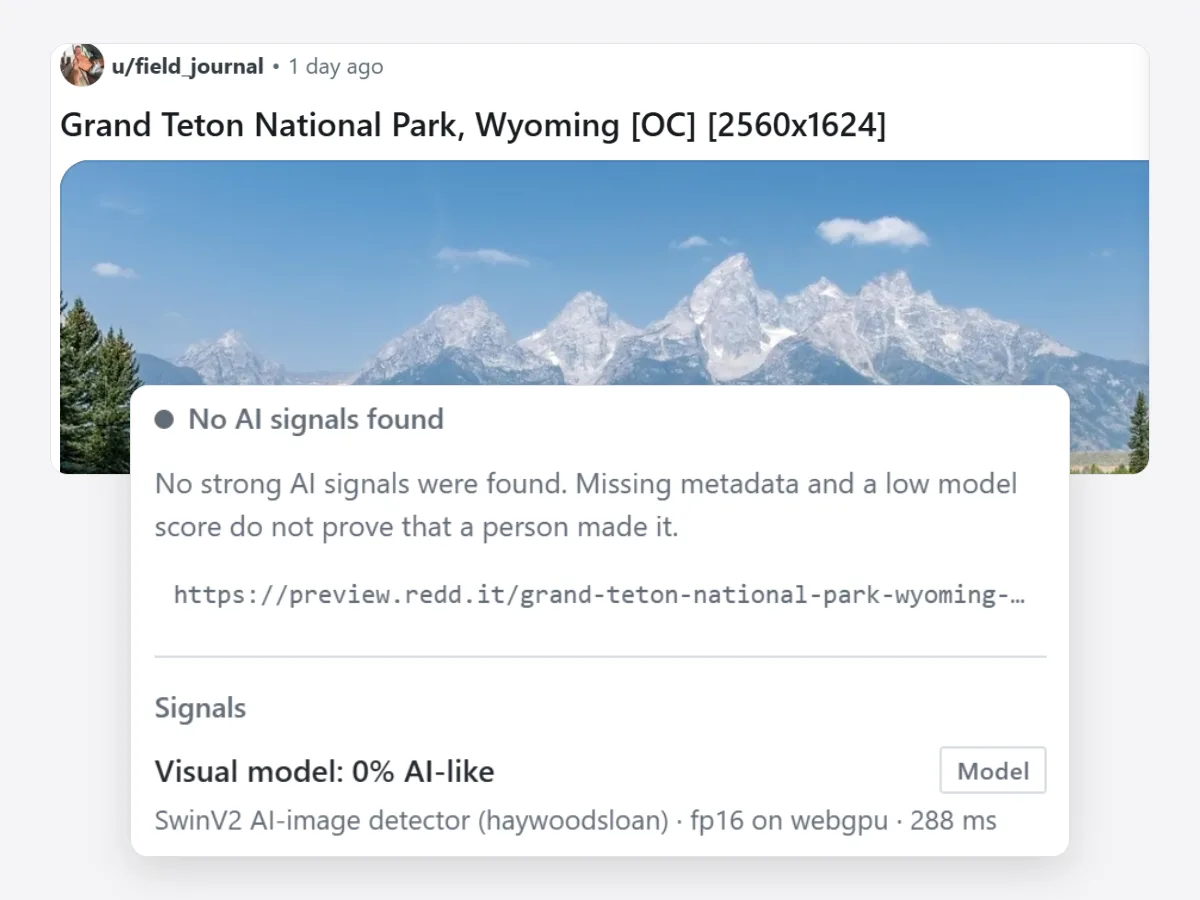
- Run it through an AI image detector, and treat the score as a hint, not a verdict.
- When it really matters, ask for the original file or a second photo.
1. Find out where the photo came from
Start with a reverse image search in Google Lens, Bing Visual Search or TinEye. You're looking for the earliest copy. AI images often show up first in AI art communities, or on accounts that post nothing but flawless, dramatic pictures.
Then look for corroboration. A real news event gets photographed from several angles by different people. One perfect image with no others behind it deserves suspicion.
2. Check what the file says about itself
Many AI tools label what they make, and the label travels inside the file:
- Content Credentials (C2PA). A signed record of how the file was made. A "digital source type" of
trainedAlgorithmicMediameans generative AI. We explain these in our Content Credentials guide. - IPTC metadata. The same "digital source type" field, used by stock agencies and some editing tools.
- Generator tags and settings. Some tools write their name into the file, and Stable Diffusion front ends such as Automatic1111 and ComfyUI often save the whole prompt.
The catch: most social platforms strip this information when they re-encode an upload. In our benchmark of 548 Reddit images, not a single one still carried a label. So a missing label tells you almost nothing. A label that is there is a strong hint, though not proof, because unsigned metadata can be edited.
3. Zoom in on the details AI still gets wrong
Generators have improved a lot, and extra fingers are rare now. These tells hold up better in 2026:
- Text. Signs, labels, license plates, book spines and logos. Look for letters that almost form words.
- Reflections and shadows. Does the reflection in a window or on water match the scene? Do the shadows all fall the same way?
- Edges and joins. Where hair meets the background, glasses meet skin, or a hand holds an object. Also jewelry, fences and railings.
- The background. Crowds with melted faces, windows whose spacing changes, leaves that dissolve into texture.
- Too clean. Skin without pores, perfectly even light, a glossy glow on everything. Heavy editing does this to real photos too, so it's a weak sign on its own.
Look at full size. Most of these are invisible at the size of a phone feed.
4. Use an AI image detector, and read the score carefully
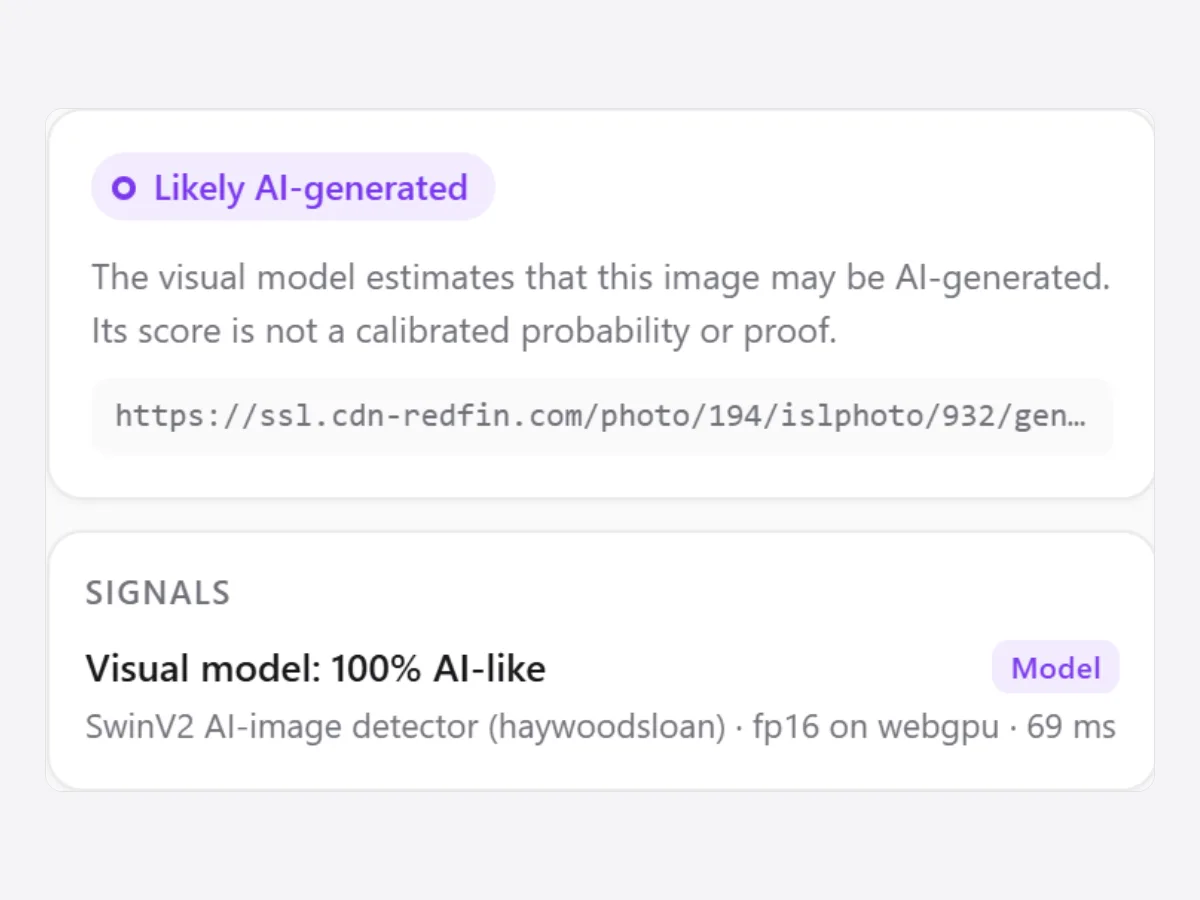
Detectors are models trained to tell generated pixels from photographed ones. They're useful, with three caveats:
- A score is the model's estimate, not a calibrated probability.
- They miss things: brand-new generators, heavily compressed images, small edits to real photos, and face swaps.
- They flag real photos too. In our tests, the model inside Hikaku caught about 65% of AI images from Reddit and wrongly flagged about 6% of real photos. On film photography, the false positive rate was 25%.
Use a detector to decide which images deserve a closer look, never as the final word.
5. When it matters, ask for more
If the answer matters, for a news story, a purchase, a rental listing or someone's reputation, ask for the original file or another photo from a slightly different angle. Real photographers usually have a dozen near-identical shots. A generated image has one.
Do the file and model checks automatically
Hikaku runs steps 2 and 4 on every image as you scroll. It reads Content Credentials, IPTC labels and generator tags, then checks the pixels with a detection model on your own computer. Images that look AI-made get a quiet outline, and clicking the tag shows exactly which signal fired.
Common questions
Can you tell for sure if a photo is AI-generated?
Not always. A signed Content Credential that says the image was generated is the strongest evidence you will usually get. Without one, you are combining hints: the photo's source, visual tells and a detector's estimate.
Are AI image detectors accurate?
They help, but they are wrong in both directions. In our Reddit benchmark the model inside Hikaku caught about 65% of AI images and wrongly flagged about 6% of real photos. Treat any detector's score as a reason to look closer, not as proof.
Does missing metadata mean a photo is real?
No. Most social platforms strip metadata from every upload, and screenshots remove it too. Missing metadata tells you almost nothing either way.
What is the fastest check?
A reverse image search, plus zooming in on any text and reflections. Together they take under a minute and catch a lot.