 Hikaku
AI vs real images: the tells that still work in 2026
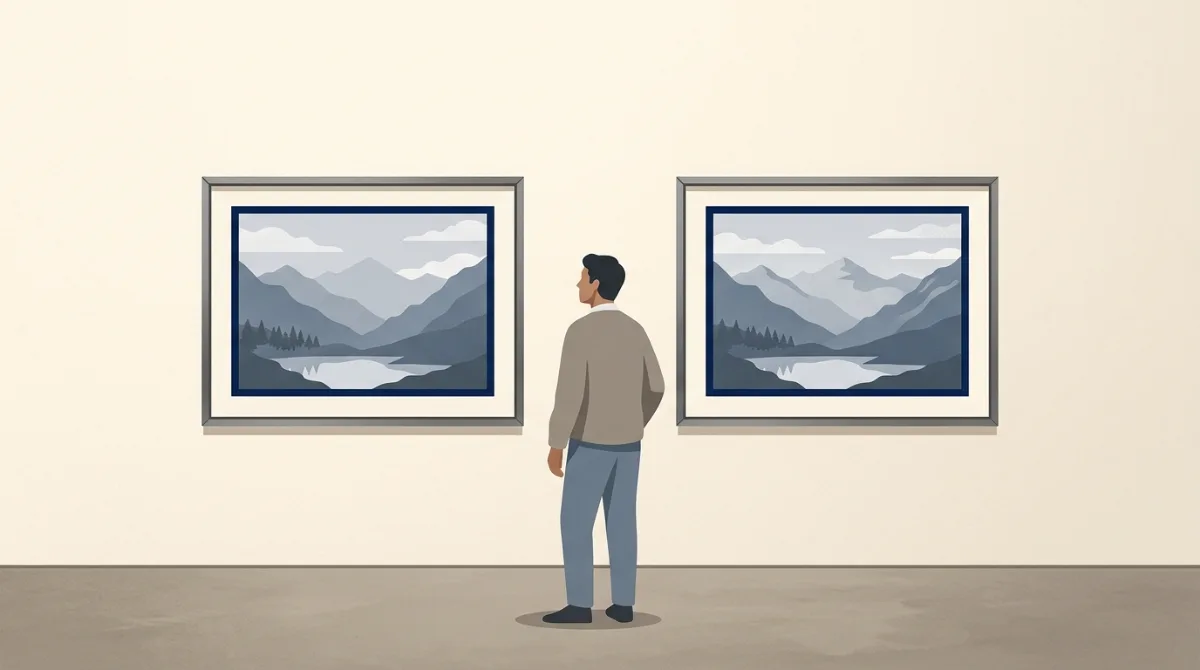
A few years ago you could spot an AI image by counting fingers. That trick is mostly dead. Today's generators make clean hands, sharp eyes and believable skin. The differences between AI and real images are still there, but they've moved to places most people don't look.
Tells that have stopped working
- Extra or missing fingers. Still happens, but rarely with current tools.
- Garbled eyes and teeth. Mostly fixed in portraits.
- "It looks too good." Professional photographers, phone night modes and editing apps produce flawless images too. Polish alone proves nothing.
Tells that still work
Zoom in to full size first. Almost all of these disappear at feed size.
- Text in the scene. Shop signs, street names, product labels, jersey numbers. AI text often looks right at a glance and falls apart when you try to read it.
- Things that should match but don't. Earrings that differ left to right, a pattern that changes partway across a shirt, window frames with different spacing on one wall.
- Physics. Reflections that show a different scene, shadows that fall in two directions, water that doesn't behave like water, hair that passes through a collar.
- Joins. Where a hand holds a cup, where glasses meet a face, where a fence meets the ground. Generators blend objects that should touch cleanly.
- The background crowd. Faces and bodies in the distance turn into smears or near-copies of each other.
- Repeating texture. Grass, gravel, foliage and brickwork that repeat in a slightly wrong, wallpaper-like way.
AI art vs real art
Spotting AI art is harder than spotting an AI photo, because art doesn't have to obey physics. A few things still help:
- Process. Human artists can usually show sketches, layers, earlier drafts or time-lapses. Ask.
- Consistency across a portfolio. A real artist's style evolves gradually. An account that switches between wildly different polished styles every week is a hint.
- Small details. Signatures that aren't letters, jewelry and buttons that melt into fabric, brush strokes that don't follow the form.
- The file itself. Some tools embed the prompt or a Content Credential. See how to check Content Credentials.
What fools people both ways
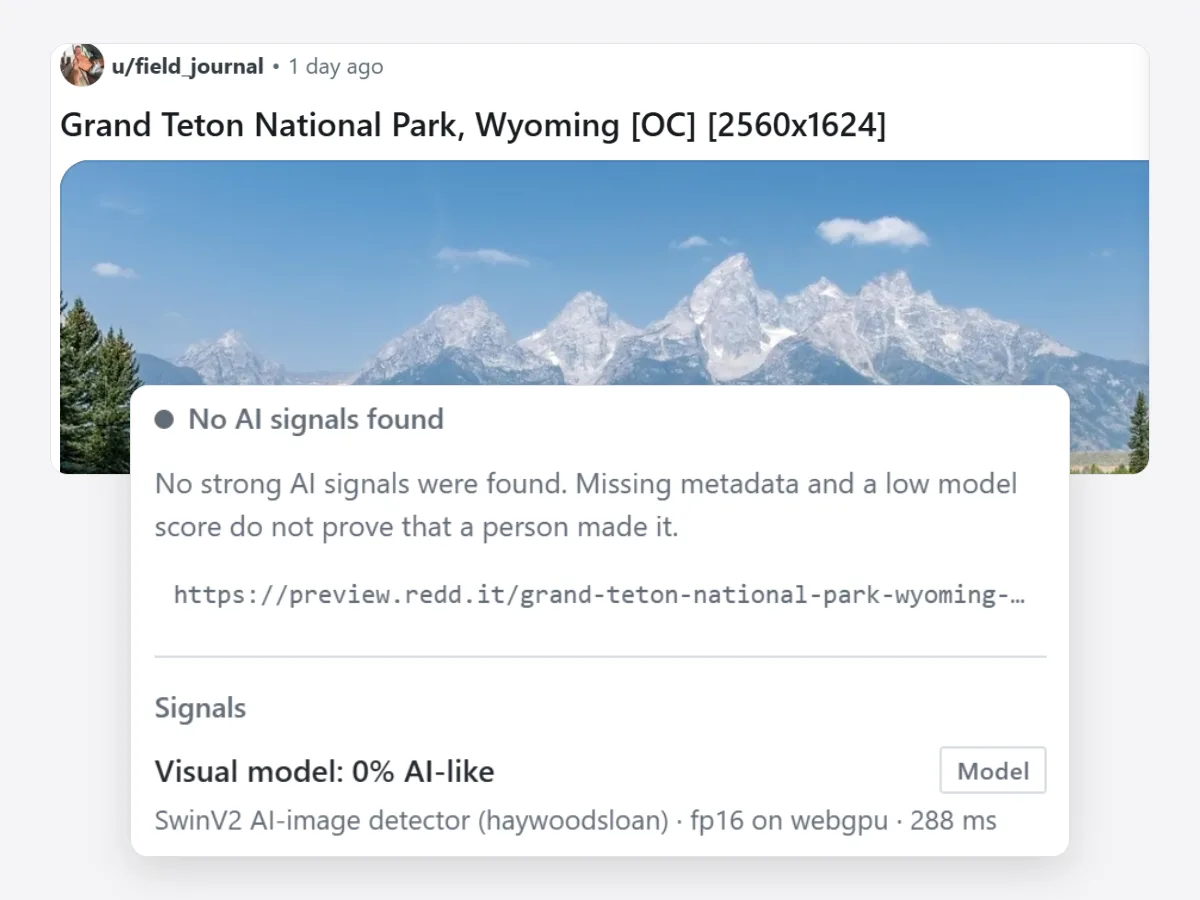
Real photos get called AI all the time: night-mode phone shots, heavily edited landscapes, film scans, product photos and 3D renders. The detector inside Hikaku has the same problem. In our benchmark it wrongly flagged 25% of film photos, against about 6% of real photos overall.
AI images get called real when they're small, compressed, or a crop of a larger image where the mistakes were cut out. Screenshots of screenshots make everything harder to judge.
A quick routine
- Zoom in on text, edges and the background.
- Check where the image first appeared with a reverse image search.
- Check the file for Content Credentials or AI labels.
- Use a detector for a second opinion, and treat its score as a hint.
The full version, with more detail on each step, is in how to tell if a photo is AI-generated.
Common questions
What is the easiest way to tell AI from real?
Zoom in on any text in the image and on places where objects touch, such as hands holding things. Those are where generators still slip most often.
Can AI images look completely real?
Yes. Many current AI images have no visible flaws at normal viewing size. That's why checking the source and the file's metadata matters as much as looking.
Why are real photos sometimes flagged as AI?
Detectors learn statistical patterns, and some real photos share them: film grain, heavy editing, night modes, renders and studio product shots. A flag is an estimate, not proof.